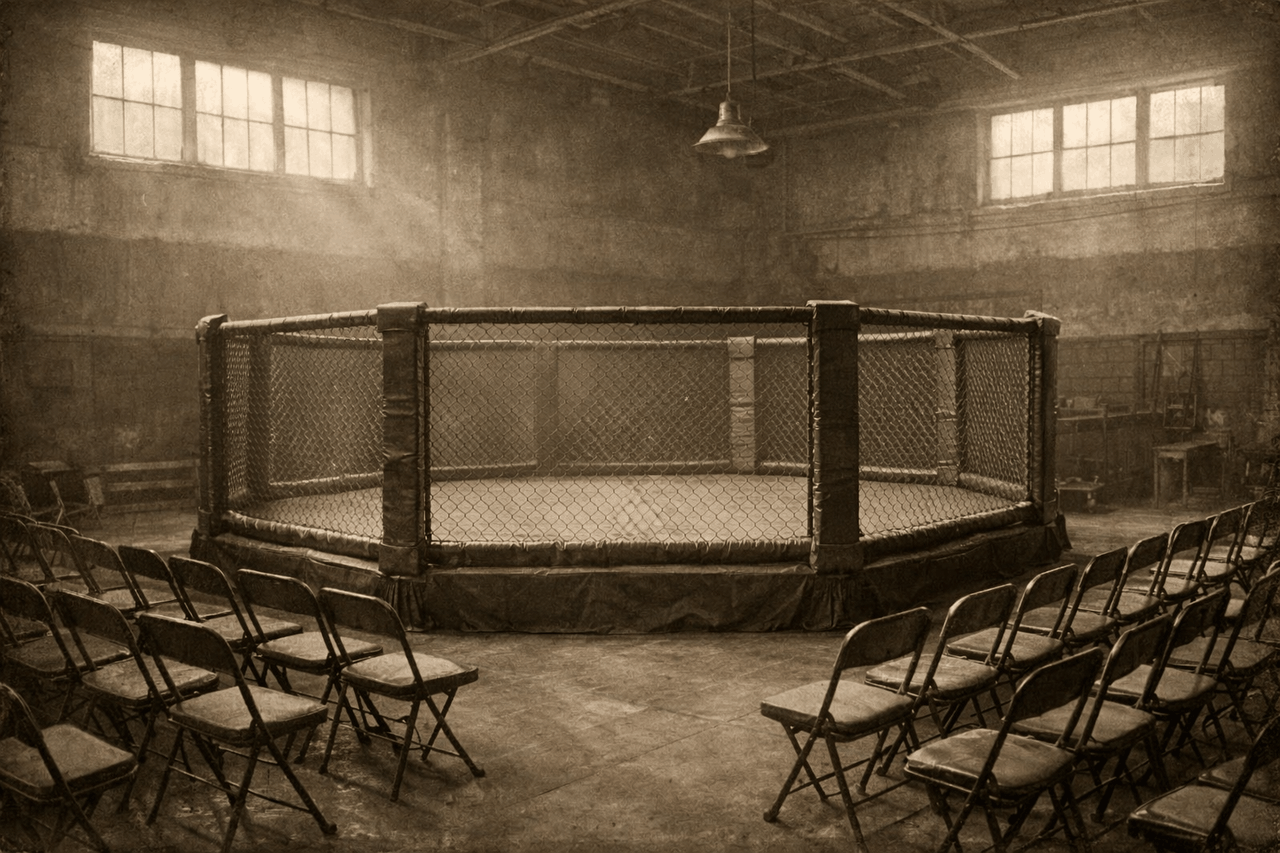
You put on UFC 1 footage and wait for something familiar: a round-ending horn, a break between rounds, perhaps a scorecard if neither fighter finishes. Those expectations belong to a later version of the sport. UFC 1, held November 12, 1993, in Denver, was an eight-man tournament without weight classes or judges. Understanding the original UFC rules starts with recognizing that different competition format.
The change to modern MMA rules happened in stages. Weight classes arrived before the UFC began using a New Jersey commission framework identified as the Unified Rules. Model rules then went through formal approval and repeated amendments. There was no single night when every part of today’s rulebook appeared.
What was different about UFC 1?
At UFC 1, the tournament bracket mattered as much as the individual matchup. Eight entrants competed to produce one tournament winner. Advancing meant remaining in contention for another bout within that event, a different task from appearing in one scheduled matchup on a modern UFC card.
There were no weight divisions separating the field. A size difference on screen was therefore not evidence that someone had missed weight for a familiar modern division. The tournament had not been organized around those divisions in the first place.
The absence of judges also changes how you should watch. You cannot explain a UFC 1 performance by saying a fighter was protecting a lead on the scorecards. There was no judging panel building that lead. Modern commentary about winning rounds cannot simply be laid over the footage.
The clock requires some care. UFC’s Hall of Fame FAQ describes early events generally as lacking time limits and standardized scoring, but early formats varied as the promotion developed. That broad description helps explain why the footage feels unfamiliar; it should not become a claim that every early UFC card used exactly the same timing rules.
Calling this era “no rules” hides the distinctions that matter to a viewer. Weight divisions, time limits, judges and tournament structure are separate features. To understand an old bout, identify the event before assuming which of those features applied.
How the rules changed, and when
February 1997: UFC 12 introduced weight classes
UFC’s timeline identifies UFC 12 as the introduction of weight classes. This changed the organizing principle for matchups: competitors could be separated by weight instead of entering one undivided field.
That milestone does not, by itself, establish a bout’s round length or judging procedure. Weight classes answer who belongs in a division. Timing and scoring rules answer how a contest proceeds and how its result is determined. Those parts of the sport developed alongside one another, rather than arriving as one complete package.
November 17, 2000: UFC 28 used an early Unified Rules framework
UFC describes UFC 28 in New Jersey as its first event under the Unified Rules. The important qualification is “its”: this is a milestone in UFC history, not a claim about the first use of such rules anywhere in MMA.
It also refers to an early commission framework. A bout conducted under that framework in 2000 was not necessarily governed by wording identical to today’s rules. New Jersey’s role helps explain the move toward a consistent regulated format, while later revisions explain why the rulebook still needs a date attached to it.
April 2001 onward: model approval and later amendments
The cover chronology of the Association of Boxing Commissions and Combative Sports’ August 2026 Unified Rules document traces model approval to April 2001 and records multiple subsequent amendments. That chronology concerns the model rules’ formal development. UFC 28’s November 2000 date concerns an event conducted under New Jersey’s earlier framework. They describe different steps in the same evolution.
For a spectator, the practical consequence is straightforward: “Unified Rules” identifies a rules framework, but the applicable version and commission still matter. A current bout should be read against the rules governing that event, rather than a remembered description of an older card.
Early UFC rules compared with modern Nevada rules
Nevada provides a concrete modern comparison. Sections 5.020 and 5.030 of its November 20, 2024 rules text set out duration and scoring provisions. They show how the clock and judges now give viewers a structure for following a bout.
| Viewing question | Historical UFC reference | Current Nevada comparison |
|---|---|---|
| When should a round end? | UFC’s retrospective describes early events generally as lacking time limits. Timing must be checked for the particular early card. | Section 5.020 sets a five-minute ceiling per round and one minute of rest, subject to the approval provisions. |
| Who is keeping score? | UFC 1, November 12, 1993, had no judges. | Section 5.030 sets out how each judge scores the action when the bout is judged. |
| What does winning a round mean? | At UFC 1, there was no judges’ round score to carry forward toward a decision. | Section 5.030 uses the 10-point must system to score rounds. |
Under the 10-point must system, the round winner ordinarily receives 10 points and the opponent receives fewer, subject to provisions such as even rounds and point deductions. The judges’ totals can determine the result when a contest reaches its scheduled end.
This gives a modern viewer two distinct things to track: what happens within each round and how those rounds accumulate on each judge’s card. Neither task describes judging at UFC 1, because that event had no judges.
Try reading the footage without modern assumptions
Consider this fictional viewing exercise. You and a friend are watching a recording labeled “UFC 1 — November 12, 1993.” There is no score graphic. Your friend says, “They must be saving the judges’ totals for the end.” What can you establish from the event’s format?
Reveal the explanation
UFC 1 had no judges, so the missing graphic does not conceal a running judges’ score. Describing either fighter as ahead two rounds to one would impose a later scoring structure on the bout.
The event label also tells you that you are watching part of an eight-man tournament without weight classes. Those facts explain the competitive setting. For footage from another early event, check that event’s format before carrying the same assumptions forward.
The useful habit is to establish the date and event first, then interpret the action. UFC 1 supplies the starting point; UFC 12 marks the arrival of weight classes; UFC 28 marks the UFC’s use of an early Unified Rules framework. Modern commission rules supply the round and scoring expectations that now feel familiar.
Sources
- UFC’s 30-year timeline — UFC 1’s date, location and tournament format, and UFC 12’s introduction of weight classes.
- UFC Hall of Fame media FAQ — early format differences and UFC 28’s status as the first UFC event under the Unified Rules.
- UFC Turns 30 Years Old — participant recollections of early changes and New Jersey’s role.
- ABC Unified Rules of MMA, August 2026 — the cover chronology of model approval in April 2001 and subsequent amendments.
- Nevada rules, November 20, 2024 — sections 5.020 and 5.030 on modern duration and scoring.